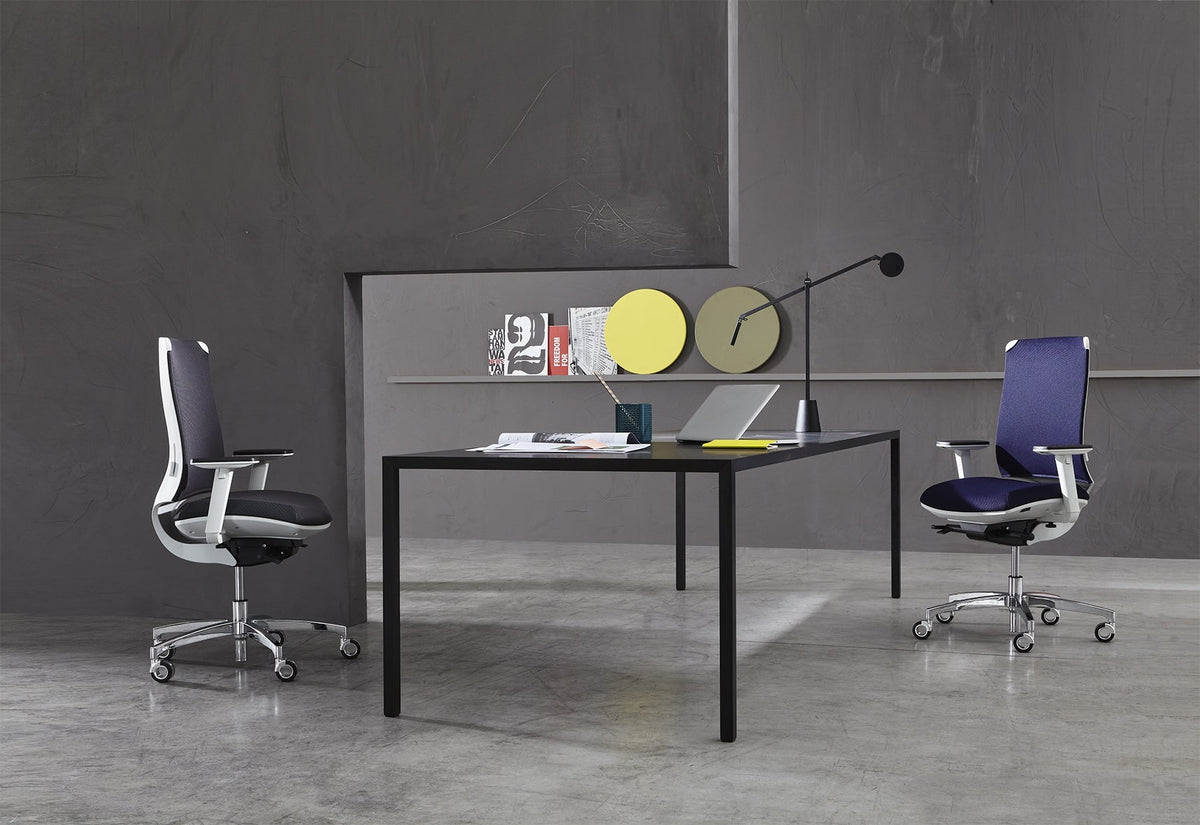
The best office chair for back pain: expert advice
The best office chair for back pain 2025: expert advice
Which chair suits you depends on the adjustment range — not on the price.
The best office chair for back pain (according to experts)
Ergonomics is not a luxury: this is how you prevent back pain at the office. You know the feeling: after a day of concentrated work your lower back feels stiff and painful. That is no coincidence. A large proportion of Dutch office workers regularly struggle with work-related back complaints. The cause? Often a poor sitting position and — crucially — an office chair that does not help back complaints but actually causes them.
As a specialist in ergonomic office interiors, we at BNR Kantoor see the impact of this every day. A good chair is not a nice-to-have, it is an essential investment in productivity and well-being. So the question is not whether you need an ergonomic chair, but which chair is best for your specific back complaints. We dive into the best office chair 2025 and give you the unvarnished advice of our own ergonomics experts.
What is an ergonomic office chair (2025 explainer)?
Put simply, an ergonomic office chair is a chair that is fully adjustable to your body and your dynamic way of working. It goes further than just a comfortable cushion; it is about supporting the natural S-curve of your spine and encouraging movement.
The essentials — NPR 1813:2025 & hybrid working: the Dutch Practice Guideline sets requirements for dimensions and adjustability. Chairs that comply with it are designed for virtually the entire working population — ideal for shared desks in hybrid offices.
An ergonomic chair adapts to your body, not the other way round.At a shared workstation, adjusting has to be possible in seconds.
The key features of the best office chair for back pain
From projects at our customers we see that the following features make the most difference:
1) Dynamic lumbar support
Adjustable in height and depth (4D) to support the curve of your lower back. On the best models the lumbar support moves with you as you lean back (synchronised mechanism).
2) Synchronised mechanism
When the backrest moves back, the seat tilts with it. That keeps the angle between torso and legs optimal and reduces the pressure on the intervertebral discs.
3) Seat depth adjustment
Set the seat so that there is 2–3 fingers of space between the seat and the back of your knee. This prevents pinching and promotes blood circulation.
4) 4D armrests
Adjustable in height, width, depth and pivot angle. Correctly set armrests relieve the shoulders and neck and reduce tension in the upper back.
Common mistakes and misconceptions about ergonomics
“A soft chair is always better.” Too soft = slumping. That actually increases the pressure on the lower back. Choose a firm, breathable seat with good contours.
“Design above all.” Good looks are fine, but never at the expense of adjustability. Ask about NPR 1813 compliance.
“I only sit for a few hours anyway.” Sitting badly causes complaints on shorter working days too. And do not forget the home workstation — occupational health and safety rules apply there as well.
Practical implementation advice: how to set up the best office chair
A top chair is only half the solution; correct adjustment is just as important. Follow these steps to relieve your back straight away:
Step
Action
Result for the back
1. Seat height
Feet flat on the floor; knees at an angle of 90–100°.
Prevents pressure under the thighs and relaxes the hips.
2. Seat depth
Slide the seat until there is 2–3 fingers of space at the back of the knee.
Full support without restricting blood circulation.
3. Lumbar support
Position the bulge at the height of your belt / natural curve.
Supports the S-curve and prevents slumping.
4. Armrests
Forearms horizontal; shoulders relaxed. Set height/width/depth/rotation.
Relieves the shoulders, neck and upper back (less tension/headache).
Expert tip: even in the perfect chair, dynamic sitting remains essential. Change posture regularly — the guideline is 40 minutes sitting, 15 minutes standing and 5 minutes moving per hour. Use the tilt function to lean back and stretch now and then.
A look ahead (2025 and beyond): sustainable and smart sitting
The market is evolving fast, driven by sustainability and technology.
Sustainability & circularity: chairs with recycled materials, modular construction and a long service life fit a corporate social responsibility policy.
Smart technology: sensors + an app that mirror your posture and movement pattern, comparable to a fitness tracker.
BNR Kantoor expects growth in circularly produced chairs that comply with NPR 1813. The focus is shifting from sitting time to sitting quality and movement.
Back pain? Choose now without regret
Back complaints cost concentration, productivity and well-being. Do you want to invest straight away in the best, occupational-health-compliant ergonomic office chair for your team or home office? BNR delivers throughout the country; on-site advice, a fast response and installation by our own team are provided within approximately 50 kilometres of Moordrecht.
What is the difference between an office chair and an NPR 1813 chair?
An NPR 1813 chair complies with the Dutch Practice Guideline for adjustability. This guarantees that the chair is suitable for a very broad public (virtually all working people), with crucial options such as seat depth adjustment, backrest height and 4D armrests.
How long may I sit at most in a day?
The healthiest approach is dynamic sitting. Preferably follow the 40-15-5 rule: 40 minutes sitting, 15 minutes standing/light activity (with a sit-stand desk) and 5 minutes moving (walking/stretching).
Is an ergonomic office chair deductible for my company?
Yes. In the Netherlands the costs of an occupational-health-compliant ergonomic workstation — including an ergonomic office chair — are tax-deductible as business expenses. Consult your accountant for the exact rules and any subsidies for sustainable/healthy investments.
Desk, meeting table and cabinet from one line: which Quadrifoglio series can do this, why the top heights differ per series and how the cabinet gets the same veneer or leather finish.